
The Ghana Voice,
Accra, Ghana
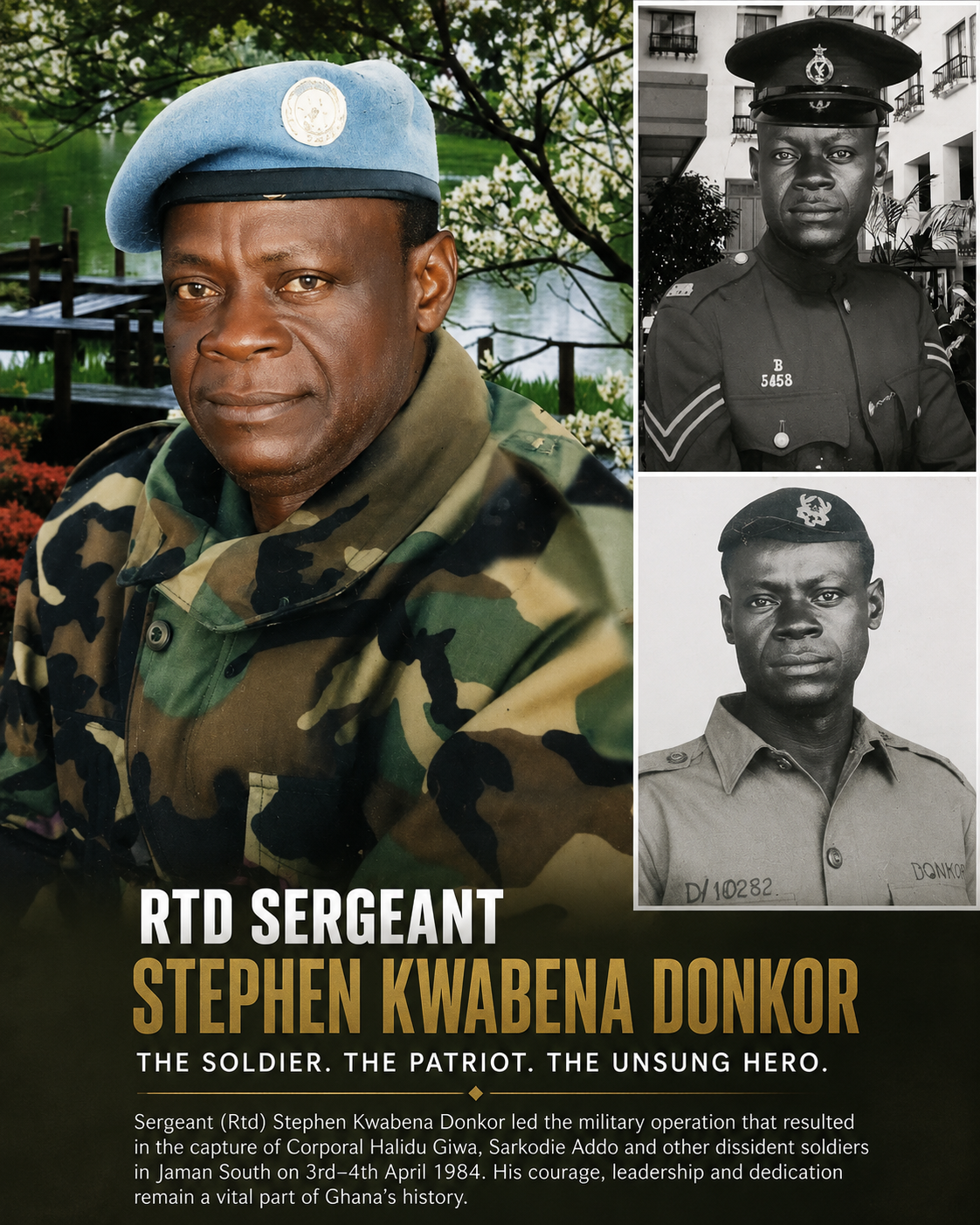
The Untold Story of the Capture of Corporal Halidu Giwa: Sergeant (Rtd) Stephen Kw abena Donkor Breaks 42 Years of Silence
The Ghana Voice 01-08-2026For more than four decades, the account of the capture of Corporal Halidu Giwa, one of the principal figures behind the failed 19 June 1983 coup against the Provisional National Defence Council (PNDC),has been widely circulated with notable gaps.
While historical narratives have extensively documented Giwa’s role in the abortive coup, his jailbreak, and subsequent execution, limited attention has been given to the soldiers who, according to a retired serviceman, risked their lives to recapture him.
Many accounts state that Giwa and his fellow dissidents were arrested at Kwame Seikrom, in present-day Jaman South Municipality, by operatives of the then Committee for the Defence of the Revolution (CDR).
However, Sergeant (Rtd) Stephen Kwabena Donkor maintains that this version omits the military personnel who, in his account, executed the operation.
Now over 80 years old, Sergeant Donkor has chosen ,after 42 years of silence, to present his account publicly for the first time, not out of resentment, he says, but from a commitment to accuracy and historical fairness.
According to him, prior to enlisting in the Ghana Armed Forces, he served for 11 years in the Ghana Police Service.
Following his military training, he was posted to Kwame Seikrom as an intelligence officer with then the Border Guards Unit.
At the time, security agencies were on high alert in the aftermath of the failed 19 June 1983 coup, with intelligence reports indicating that dissident soldiers who had fled to Côte d’Ivoire and Togo were attempting to infiltrate Ghana.
Personnel stationed along the border frequently received alerts with the warning, “The boys are coming,” indicating possible movement of the dissidents.
Sergeant Donkor recalls that on 3 April 1984, intelligence gathered by the late Corporal Yehunu, popularly known as “Cocoa Sika,” together with police personnel from Japekrom, indicated that seven suspicious individuals, believed to be dissident soldiers,had entered the border area at the Kromonomu Barrier (between Gonasua and KwameSeikrom).
Among them, he says, was Sergeant Bediako, a native of the Jaman area familiar with the terrain.
According to Sergeant Donkor, local residents became involved in the operation after the suspects were observed travelling in a vehicle with registration number BA 3333.
The vehicle had reportedly been provided by a local resident, Koo Mensah, for the operation.
The suspects were subsequently intercepted, arrested, and placed in custody.
He disputes claims that CDR operatives effected the arrests, arguing that at the time they would not have had the capacity to identify the number of suspects or their individual identities.
The situation, however, soon turned tragic.
Sergeant Donkor recounts that Corporal Yehunu was unarmed and had borrowed a locally manufactured single-barrel firearm from a resident identified only as Abu, who is still alive, to guard the detained suspects.
The dissidents, however, overpowered him(Corporal Yehunu), stabbed him in the neck, seized the weapon, and escaped.
According to Sergeant Donkor, five of the fugitives fled through Kwame Seikrom towards Kikam and Kofiko, while two others, Sergeant Bediako and Corporal Akpatinga, took a separate route.
He stated that he and four colleagues, Sgt A. A. Arthur, Corporal Avorgedor Robert, Lance Corporal Kodjovi, and Private Musah Barrow proceeded to Berekum to check on their injured colleague, Corporal Yehunu, and en route passed through Drobo to inflate their vehicle tyre.
The decisive breakthrough, he recalls, came after receiving critical intelligence from a local resident popularly known as Pozo, a son of the late Drobo chief, Nana Adinkra Kosopre.
Pozo (who is still alive) reportedly informed the team that the fugitives had requested directions to Sampa while travelling in a Nissan Hommer vehicle, apparently attempting to return to Côte d’Ivoire.
Although he initially assisted them, he later withdrew his cooperation after they declined to give him a pair of sneakers he had admired.
He subsequently relayed this information to Sergeant Donkor and his team.
Acting on this intelligence, Sergeant Donkor and his team abandoned their trip to Berekum and pursued the suspects, eventually intercepting them between Asare Town and Adamsu.
It was during the arrest, he says, that he personally removed more than twenty talismans and amulets from the body of Corporal Halidu Giwa. The remaining suspects were also found with protective charms tied around their upper arms. Sergeant Donkor states that he carefully collected all the items into a paper bag.
At that stage, he notes, the identities of the detainees were still unknown until a CDR operative, Owusu Antwi (Nana Owusu Antwi), together with the then Head of the Jaman CDR, the late Julius Atta Bediako, arrived and identified Corporal Halidu Giwa.
According to Sergeant Donkor, Giwa reacted angrily, stating, “What do you mean? Where do you know me from?” He adds that the CDR operatives warned him and his team of serious consequences should the suspects escape.
Sergeant Donkor also seeks to correct another widely circulated account.
He states that it is inaccurate to suggest that a soldier went mad after wearing Giwa’s sneakers. Rather, he claims that one of his men mistakenly wore one of Giwa’s talismans around his neck and subsequently developed mental illness.
He further notes that all the arrested individuals wore similar marching sneakers.
During transport, the prisoners allegedly attempted to disarm their escorts near the Adamsu Cemetery. In the ensuing struggle, a firearm discharged, striking Corporal Sarkodie Addo in the thigh.
The vehicle overturned, allowing Corporal Halidu Giwa and two others to escape into the bush. While fleeing, Giwa was shot in the thigh, and the team later tracked him via a blood trail and recaptured him as he lay exhausted under a tree.
The other two fugitives escaped. According to Sergeant Donkor, upon recapture, Giwa stated: “I am Corporal Halidu Giwa. You people called us to come, but after we came, you are chasing us. I have killed 30 people. If you kill me, you have done nothing.”
The three recaptured suspects, including Corporal Halidu Giwa and Corporal Sarkodie Addo, were subsequently transported to Japekrom.
Sergeant Donkor states that he followed in another vehicle driven by CDR operative Owusu Antwi, now the Chief of Pampaso in Kumasi under the stool name Nana Owusu Antwi.
Sergeant Bediako and Akpatinga were later apprehended by CDR operatives after being reportedly sighted near the Drobo lorry station and handed over to police at Japekrom.
He further recalls that Giwa requested to be taken before Flight Lieutenant Jerry John Rawlings prior to any execution. However, it was reported that Flt Lt Rawlings declined the request.
Despite what he considers a central role in the operation, Sergeant Donkor says his contribution and that of his team has not been formally acknowledged. According to him, public accounts have consistently credited CDR operatives while overlooking the military personnel who tracked and apprehended the fugitives.
He states that General Arnold Quainoo later assured the team of promotion. Although two members reportedly benefited, his own promotion was never effected. Despite performing duties at the rank of Sergeant, he retired officially as a Corporal.
He says he submitted several petitions for redress but did not receive a satisfactory response.
The only recognition he recalls receiving was selection for a peacekeeping mission to Lebanon approximately eight years after leaving active service. While appreciative of the opportunity, he considers it insufficient recognition for his service and sacrifice.
His challenges, however, did not end upon retirement.
After returning to his hometown of Kwasibuokrom, he says he faced hostility from sections of the community because Sergeant Bediako, one of the arrested dissidents was both a native of the town and his brother-in-law.
This situation, he says, compelled him to relocate before eventually settling permanently in Japekrom after his return from Lebanon.
He expresses deep appreciation to the Member of Parliament for Jaman South, Colonel (Rtd) Kwadwo Damoah, whom he credits with providing significant assistance during his time in Lebanon and later supporting his resettlement in Japekrom.
Sergeant (Rtd) Donkor later served as Commander of the Jaman Militia from 1989 until its dissolution.
Today, Sergeant (Rtd) Stephen Kwabena Donkor, who is partially blind, lives quietly in retirement with his wife and family, still without formal national recognition for the role he and his team played in the capture of one of Ghana’s most notorious dissidents.
He survives on his Corporal retirement benefits, yet speaks without bitterness.
What remains, he says, is a quiet hope that his account will one day be acknowledged and properly reflected in the historical record.
He believes it is not too late for the NDC, as successor to the PNDC, to recognise his contribution to the early struggles that shaped the party.
Widely regarded as one of the founding figures of the National Democratic Congress (NDC) in the Jaman area and an organiser of its early Cadres movement and even in retirement has formed a 25 member retired Cadres group,Named the Patriots.
He says he has remained involved in the party’s activities since its inception, without seeking personal reward.
“If I had to go back in time,” he says softly, “I would still do exactly what I did in defence of my country.”
His only wish now is that the historical record accurately reflects the events of 3–4 April 1984, and that the contributions of the soldiers involved in the operation are formally acknowledged alongside the widely known account of Corporal Halidu Giwa