
The Ghana Voice,
Accra, Ghana
B5 Plus Phase 2 Ignites Fresh Debate Over Tax Incentives, Policy Continuity and Ghana’s Industrial Future
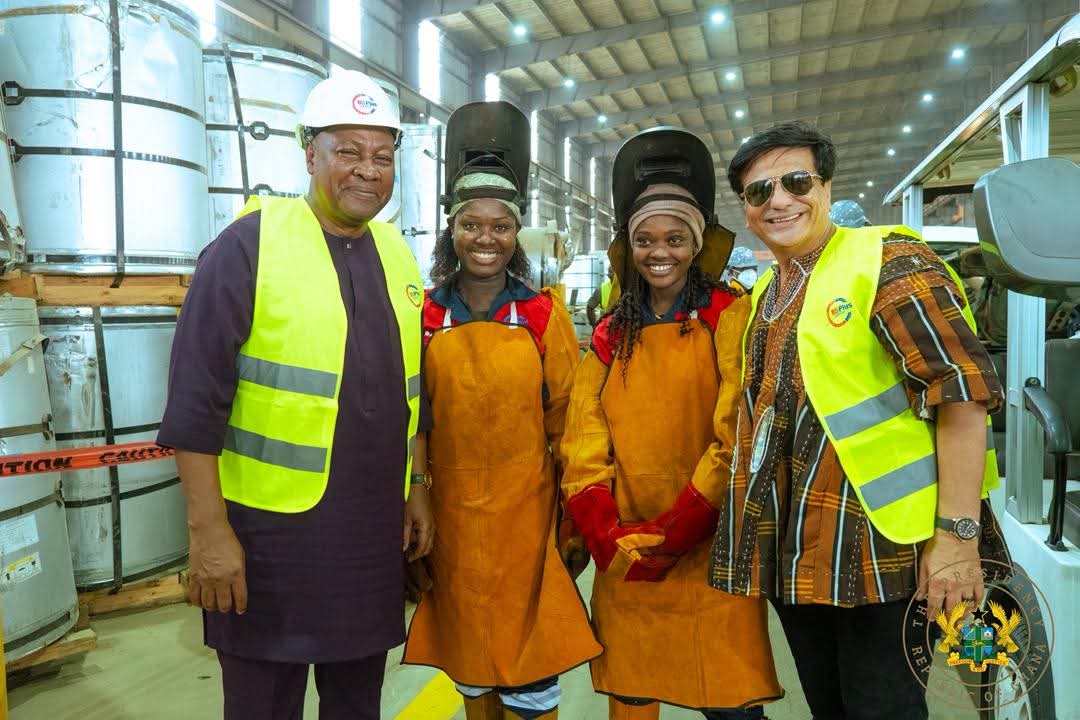
The Ghana Voice 21-02-2026The commissioning of Phase Two of the B5 Plus Steel Ball Mill and Section Mill Manufacturing Plant has reignited a familiar national conversation on how Ghana should balance industrial ambition with fiscal prudence.
At a ceremony on Friday, February 20, President John Dramani Mahama described the expanded facility as a “bold step” toward industrial transformation and a practical pillar of his administration’s proposed 24-Hour Economy policy.
According to the President, reducing steel imports by even 20 to 30 percent could save Ghana hundreds of millions of dollars in foreign exchange annually, resources that could be redirected to infrastructure, healthcare and education.
The plant, operated by the B5 Plus Group, significantly expands domestic production capacity. It will manufacture structural steel sections, grinding media balls for the mining sector, pre-engineered building systems, heavy industrial structures, trailers and warehouse components that Ghana has historically imported at high cost.
“Steel consumption is a strong indicator of industrial development,” President Mahama noted, linking rising domestic steel production to broader economic growth, urbanisation and infrastructure expansion.
Yet this is not the first time B5 Plus has found itself at the centre of Ghana’s industrial narrative.
On April 13, 2021, then-President Nana Akufo-Addo commissioned Phase One of the plant under the government’s One-District-One-Factory (1D1F) initiative. The project was presented at the time as proof that value-added industrialisation within a business-friendly environment was gaining momentum.
Under the 1D1F stimulus framework, B5 Plus reportedly benefited from approximately $11.4 million in tax exemptions wbuch was aimed at strengthening local manufacturing capacity.
What has changed between 2021 and today is not the factory ,but the politics surrounding it.
Critics now argue that the company is leveraging successive industrial policies — first 1D1F, now the 24-Hour Economy to secure generous tax waivers while delivering insufficient social returns.
Dr. Richard Apau,a Computer Scientist,has accused the company of capitalising on what he describes as political gullibility, alleging that workers are sometimes underpaid and that exemptions are being pursued primarily for corporate advantage rather than national development.
On the other side, Krobea Kwabena Asante, an aide to former Vice President Dr. Bawumia, has questioned what he sees as political inconsistency. He argues that figures who previously criticised tax waivers under 1D1F now celebrate B5 Plus as a flagship of the 24-Hour Economy narrative.
The tension exposes a broader issue in Ghana’s policy landscape: are tax incentives strategic development tools, or are they politically convenient instruments deployed by successive governments to signal industrial progress?
Economists note that tax exemptions are not inherently problematic.
Across emerging markets, from Southeast Asia to parts of Latin America ,carefully structured incentives have catalysed manufacturing growth, built local capacity and reduced import dependence.
However, such incentives succeed only when three conditions are met:
Transparency – Clear disclosure of exemptions and their fiscal cost.
Performance benchmarks – Measurable employment targets, wage compliance and local value addition.
Time-bound frameworks – Defined sunset clauses to prevent permanent revenue leakage.
Without these safeguards, exemptions risk eroding public trust ,especially in a country grappling with debt restructuring and revenue mobilisation challenges.
For workers inside the factory, the debate is not about ideology but livelihoods. Industrial expansion promises employment, technical skill development and ancillary business growth in logistics, construction and mining supply chains.
Yet allegations of wage underpayment, if substantiated would undermine the moral case for continued state support as Industrial sovereignty cannot come at the expense of labour standards.
Labour analysts argue that industrial policy must align with enforcement of minimum wage laws, occupational safety regulations and collective bargaining rights. Industrial growth that suppresses wages risks deepening inequality rather than broadening prosperity.
The B5 Plus case also reveals an uncomfortable truth about Ghana’s industrial discourse: policies often change names while retaining similar structural incentives.
The 1D1F programme sought to decentralise manufacturing. The 24-Hour Economy aims to maximise productivity through extended operational cycles. Both rely heavily on private sector investment supported by state-backed incentives.
What differs is branding and political ownership.
In that sense, B5 Plus represents something larger than a steel plant. It symbolizes the continuity and contestation of Ghana’s industrial strategy across administrations.
At its core, the controversy forces policymakers to answer a difficult but necessary question:
Should Ghana prioritise immediate tax revenue, or sacrifice some short-term inflows to build long-term manufacturing capacity?
If domestic steel production can significantly reduce imports, improve trade balances and supply the mining and construction sectors locally, the macroeconomic gains could outweigh the cost of incentives. But that calculation must be evidence-based, transparent and insulated from partisan spin.
As Ghana pushes toward economic recovery and structural transformation, the Phase Two commissioning of B5 Plus may serve as a litmus test.
If the plant delivers sustained employment, fair wages, measurable import substitution and value-chain development, it could validate the industrial incentive model.
If not, it risks reinforcing public scepticism about corporate-state partnerships.
In a politically polarised climate like Ghana, one fact remains constant: steel does not vote, but workers, taxpayers and consumers do. And they will ultimately judge whether Ghana’s industrial policies are building factories for headlines or foundations for lasting prosperity.