
The Ghana Voice,
Accra, Ghana
Ghana Triggers International Arbitration Over Maritime Boundary Dispute with Togo
The Ghana Voice 20-02-2026The Government of Ghana has formally notified the Government of Togo of its decision to initiate international arbitration to delimit the maritime boundary between the two neighbouring states under the framework of the United Nations Convention on the Law of the Sea (UNCLOS).
The move, announced by Felix Ofosu Kwakye, Spokesperson to the President and Minister for Government Communications, comes after eight years of bilateral negotiations that failed to produce a mutually agreed settlement.
According to the statement, Ghana’s decision follows sustained diplomatic engagements that did not yield consensus on the exact delimitation of the maritime boundary. The government maintains that resorting to arbitration is aimed at preventing further escalation of tensions that have arisen between certain state institutions of both countries.
Under the provisions of the United Nations Convention on the Law of the Sea, state parties are permitted to refer unresolved maritime boundary disputes to compulsory dispute settlement mechanisms, including arbitration. Ghana’s action signals a transition from political negotiation to a rules-based, legal resolution framework.
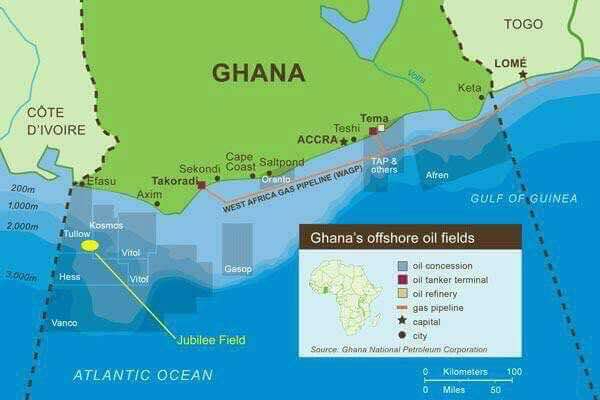
Maritime boundary delimitation is not merely a cartographic exercise. It determines sovereign rights over territorial waters, exclusive economic zones (EEZs), and access to offshore natural resources, including fisheries and hydrocarbons.
For Ghana, which has developed a significant offshore oil and gas industry over the past decade, legal certainty over maritime boundaries is critical for investor confidence, energy security, and the protection of economic interests. Disputed or undefined boundaries can complicate exploration activities, licensing regimes, and maritime security operations.
For Togo, whose coastline is relatively short but strategically positioned along the Gulf of Guinea, clarity over maritime limits equally affects fishing rights, port operations, and potential offshore resource exploration.
Ghana has previously resorted to international adjudication to resolve maritime disputes. In its case against Ivory Coast before the International Tribunal for the Law of the Sea (ITLOS), the court delivered a binding judgment in 2017 that clarified the maritime boundary between the two countries. That ruling reinforced Ghana’s commitment to resolving such disputes through legal and peaceful means.
Analysts say the decision to pursue arbitration rather than prolong stalled negotiations reflects Accra’s confidence in international legal mechanisms and its desire to avoid diplomatic deterioration.
While arbitration formalizes the dispute, it does not necessarily signify a breakdown in relations. Ghana’s statement emphasised the spirit of good neighbourliness and continued cooperation. However, the process may temporarily heighten diplomatic sensitivities, particularly if interim measures are sought or if activities in contested waters continue.
In the broader Gulf of Guinea context—where maritime security concerns such as piracy, illegal fishing, and resource competition persist—a clearly defined boundary could ultimately enhance cooperation between Accra and Lomé by removing ambiguity.
The referral of the matter to arbitration underscores the growing reliance on international legal frameworks in West Africa to manage complex sovereignty questions. If handled constructively, the process could reinforce the region’s adherence to rules-based dispute resolution rather than political brinkmanship.
For both Ghana and Togo, the outcome will shape not only access to maritime resources but also the tone of bilateral relations in the years ahead. The arbitration, once constituted, will deliver a binding decision—bringing legal finality to a dispute that diplomacy alone could not resolve.