
The Ghana Voice,
Accra, Ghana
Ghana’s Property Rate System Under Scrutiny as Governance Expert Calls for Urgent Reforms
The Ghana Voice 07-02-2026Ghana’s local government financing model is facing renewed scrutiny following concerns that weak property rate systems are undermining municipal development and service delivery across the country.
Governance expert and Executive Director of the Ghana Center for Democratic Development (CDD-Ghana), Prof. H. Kwasi Prempeh, has raised critical questions about the efficiency, structure and sustainability of property rate collection in Ghana, drawing comparisons with systems in developed jurisdictions such as the United States.
Stark Contrast in Property Tax Systems
In a reflective commentary highlighting his personal experiences living in two different municipalities, Prof. Prempeh contrasted property tax administration in the United States with Ghana’s current system.
According to him, property taxes serve as the primary source of funding for local governments worldwide, supporting essential public services such as infrastructure maintenance, sanitation, and community development.
He recounted receiving a property tax bill during his time in the United States that clearly identified him as the property owner, detailed payment schedules, and outlined penalties for late payment. The system, he noted, also provided structured payment methods and clear accountability mechanisms.
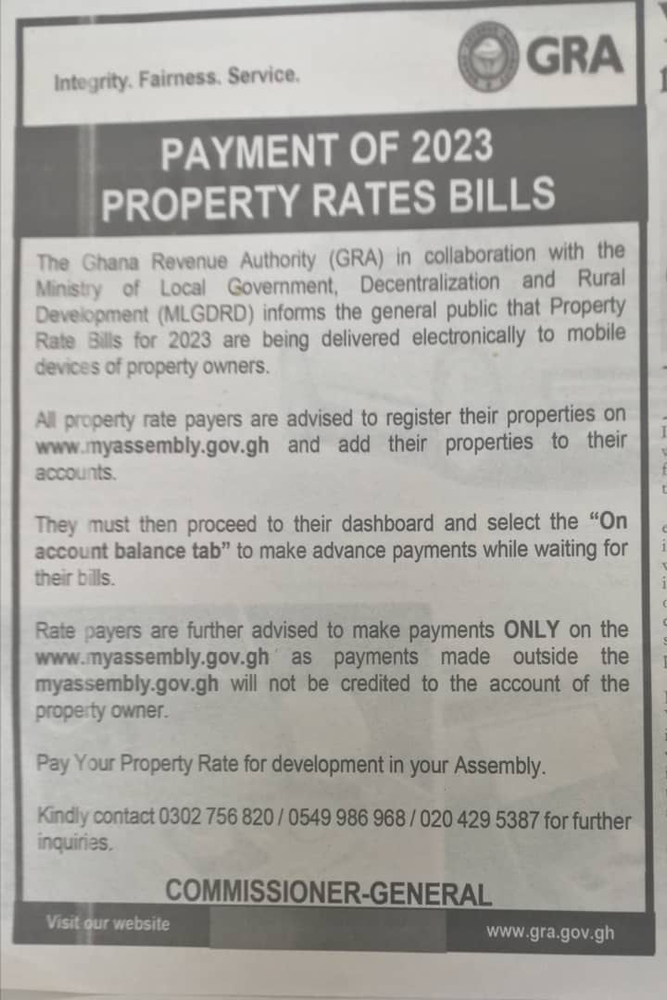
By comparison, he described Ghana’s property rate billing system as largely manual and inefficient. In his recent experience in Accra, he indicated that his property rate bill carried only the GPS address of the property, lacked payment instructions and required physical visits by local tax collectors to secure payment.
Challenges with Collection and Compliance
Prof. Prempeh also raised concerns about the limited enforcement mechanisms surrounding property rate payments. He noted that some assemblies reportedly do not track or collect arrears, potentially weakening revenue mobilisation.
He further highlighted logistical inefficiencies in the collection process, including situations where tax collectors rely on cash payments or personal mobile money accounts instead of official municipal payment platforms.
According to him, such practices not only pose accountability and transparency risks but also increase operational costs, which may outweigh the revenue generated.
Low Revenue Base Limiting Local Development
Another key issue raised relates to the comparatively low property rate charges in Ghana. Prof. Prempeh suggested that current rates are insufficient to support meaningful infrastructure development or improve local service delivery.
He argued that resistance to property rate payments among residents further compounds the problem, creating a cycle of underfunded municipal services and weak public confidence in local government performance.
Structural Dependence on Central Government
The governance expert also criticised what he described as a structural imbalance in Ghana’s local government financing framework.
He pointed out that many metropolitan, municipal and district assemblies depend heavily on central government funding, including for staff salaries and recurrent expenditure. This, he argued, reduces the incentive for assemblies to strengthen internal revenue mobilisation through property rate collection.
“Without strong local revenue systems, municipalities will continue to rely on central government support, which undermines fiscal accountability and local development planning,” he suggested.
Calls for Comprehensive Reform
Prof. Prempeh is calling for a comprehensive overhaul of Ghana’s property rate administration system, including improved property valuation processes, digital billing and payment platforms, stronger enforcement mechanisms and enhanced transparency.
He also questioned the continued creation of new administrative districts without corresponding reforms to strengthen their financial sustainability.
Broader Implications for Urban Development
Urban planning and governance analysts have long identified weak property tax systems as one of the major constraints to city development across many African countries. Experts argue that strengthening property rate systems could significantly boost municipal revenue, enabling assemblies to invest in infrastructure, sanitation, roads and public safety services.
With Ghana’s urban population expanding rapidly, policy analysts say modernising property rate administration could play a critical role in supporting sustainable urban growth and improving quality of life in major cities such as Accra, Kumasi, Takoradi and Tamale.
A National Policy Debate Emerging
The issues raised by Prof. Prempeh have reignited discussions about fiscal decentralisation and the future of local governance in Ghana. Stakeholders are increasingly questioning whether current financing models can support growing urban infrastructure demands.
As Ghana continues to pursue decentralisation reforms, experts say strengthening local revenue mobilisation systems will be essential to ensuring that metropolitan and municipal assemblies can operate efficiently and deliver services effectively.