
The Ghana Voice,
Accra, Ghana
Courtesy Calls, Political Memory and the Optics of Power: Rethinking the Nana Aba–Ablakwa Moment
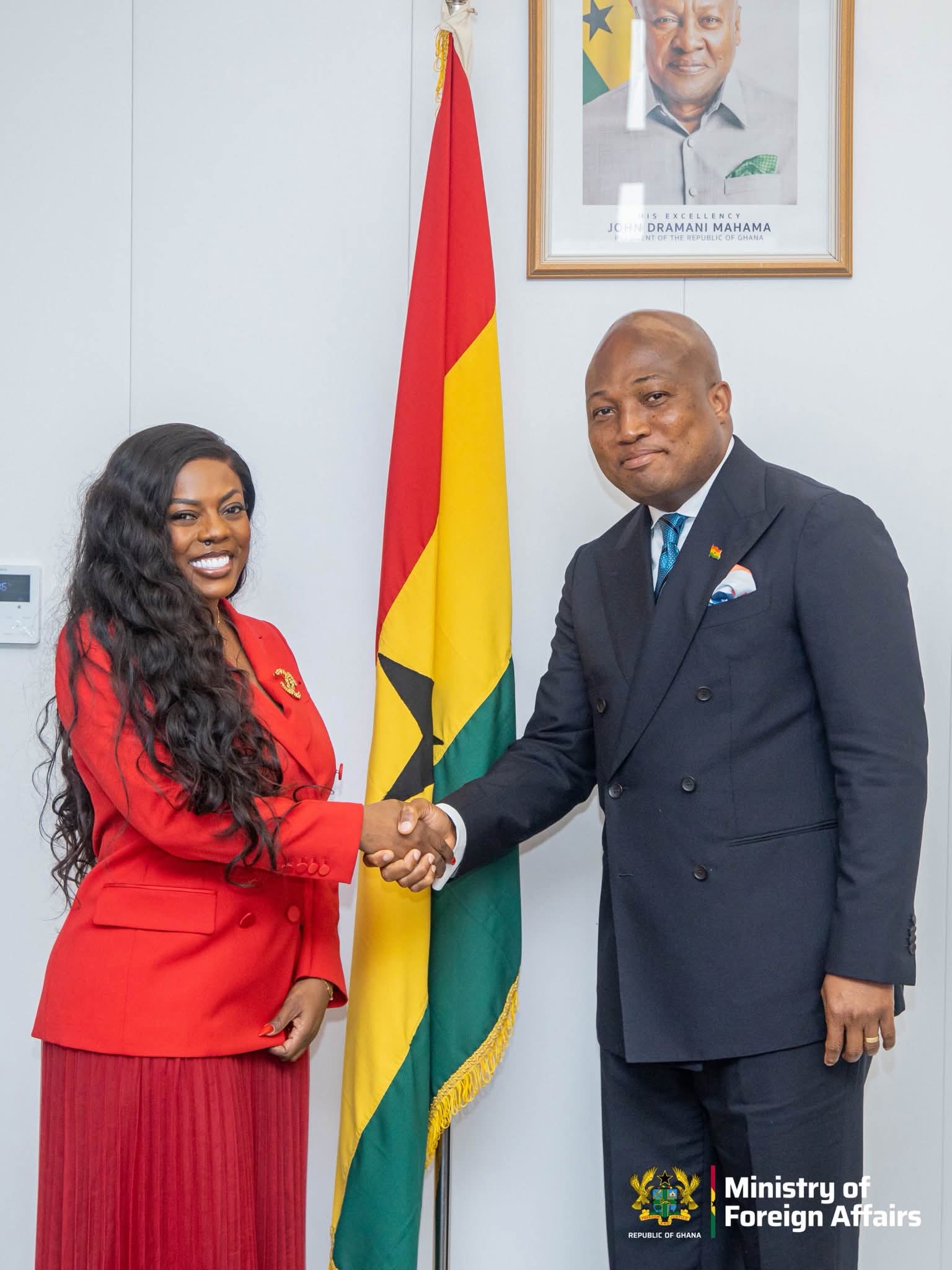
Lawrence 21-01-2026Politics, by its very nature, is complex and often contradictory. It thrives on alliances, realignments and strategic reconciliations. Yet, it is also sustained by memory, loyalty and sacrifice. The recent courtesy call by media personality and Women of Valour founder, Nana Aba Anamoah, on the Minister of Foreign Affairs, Hon. Samuel Okudzeto Ablakwa, has exposed this tension in sharp relief.
At the surface level, the visit appears harmless — a civil society engagement with a government official, framed around women’s empowerment and international visibility. But politics is rarely judged only by intention. It is judged by optics, timing, history and symbolism. And it is within these dimensions that the controversy lies.
The Nana Aba Question: Rights, Records and Responsibility
There is no dispute that Nana Aba Anamoah, like every citizen, has the right to her political opinions and affiliations. During the 2024 election cycle, she exercised that right forcefully. Her public interventions — questioning polling credibility when it favoured John Mahama, engaging children on live television to label Mahama the “Dumsor King,” and most notably her September 2024 statement dismissing the NDC’s governance claims as “a big joke” — were not neutral observations. They were deliberate political acts at a critical moment.
This is not about punishing dissent. It is about political accountability. When an individual who actively undermined a party’s credibility shortly before an election later appears embraced by that same party after victory, questions naturally arise. What has changed? Has there been reflection? Is there acknowledgment? Or is proximity to power enough to reset the narrative?
Without clarity, the optics for Nana Aba are mixed. To some, she appears pragmatic, navigating power as many elites do. To others, she appears politically unaccountable — benefiting from the success of a movement she publicly disparaged, without explanation or reconciliation.
The NDC Optics: Winning Power vs Sustaining a Movement
The argument that “there are no permanent enemies in politics” is not wrong — but it is incomplete. That maxim operates best at the elite level, where interests shift and negotiations occur quietly. Political parties, however, are not sustained by elites alone. They are built and defended by grassroots supporters who absorb insults, endure marginalisation, and remain loyal when it is costly to do so.
When those supporters watch former vocal opponents receive public validation after victory, the signal can be damaging. It suggests that loyalty is optional, opposition carries no cost, and sacrifice has no long-term value. History offers cautionary lessons. The NDC’s post-2012 “father-for-all” posture blurred the line between loyalty and opposition, weakening morale gradually rather than immediately.
For a party that just secured power after intense mobilisation, the challenge is not only governing effectively but preserving internal cohesion. Inclusion is necessary, but inclusion without boundaries risks eroding the very base that made victory possible.
Okudzeto Ablakwa’s Position: Statesmanship or Strategic Miscalculation?
Hon. Okudzeto Ablakwa is widely regarded as disciplined, ideologically grounded and deeply respected within the NDC base. That reputation explains why this moment has drawn particular scrutiny. His public endorsement of Nana Aba — however well-intentioned — elevated what could have been a quiet engagement into a symbolic political statement.
As a senior figure and Foreign Affairs Minister, Ablakwa operates on both domestic and international stages. Courtesy calls are part of the job. But public politics is not only about what is done; it is about how it is framed. In a highly polarised environment, optics matter. A more discreet engagement may have avoided unnecessary controversy while achieving the same substantive ends.
This does not make the minister wrong. But it does suggest a moment where political sensitivity may have been underestimated.
Between Realpolitik and Political Discipline
Politics allows change. People evolve. Former opponents can become allies. Even the idea of welcoming an opposition figure — hypothetically, even a Dr. Bawumia — is defensible within strategic logic. But serious political movements reconcile with care. They manage transitions thoughtfully. They respect memory.
Reconciliation without accountability looks like weakness, not maturity. Inclusion without clarity creates confusion, not unity. Strong movements balance openness with discipline, and pragmatism with respect for sacrifice.
The current debate is therefore not about personal animosity toward Nana Aba Anamoah, nor an attack on Hon. Okudzeto Ablakwa. It is a broader conversation about how power is exercised, how memory is treated, and how political capital is preserved after victory.
In the end, politics may have no permanent enemies — but it certainly has permanent consequences. And how this moment is understood, managed and learned from will say much about the kind of political culture the NDC intends to build going forward.